Ignite Thesis
The Environment Always Wins
The Communications and Training Were Fine. The Environment Wasn’t.
Miguel Guevara, Ignite Consulting
↓ Download PDFWhat’s in This Document
Part One: The Diagnosis. The pattern, the framework, what AI changed, and where most organizations stall
Part Two: The Application. For Executive Sponsors|For Frontier-Tech Operators|For PE Operating Partners
Part Three: For Practitioners. The full evidence base: market economics, research, and how the engagement runs
Part One: The Diagnosis
For sponsors, operators, and portfolio leaders. Read time: 10 minutes.
The Pattern You Already Recognize
We went live on a Tuesday. By Thursday, half the org had returned to the legacy system.
Not because they didn’t understand the new process. Not because the training was bad. Because the environment still made the old way easier. The workaround was faster. The manager’s scorecard still measured the old metric. The approval chain hadn’t changed. Nobody had closed the path back.
If that sounds familiar, keep reading.
The communications went out. The training ran. The system went live. Six months later, the workforce was working around it instead of in it. The project team asks for more training. The sponsor schedules a town hall. The workaround survives both.
The gap is environmental. It closes when the environment changes. It doesn’t close when you send another email, run another workshop, or add a dashboard that measures the wrong thing more precisely.
The cost isn’t just failed adoption. It’s stranded investment. The technology works. The business case doesn’t.
This isn’t a people problem. It’s an architecture problem. Change fails not because organizations don’t know what to do, but because the sponsor hasn’t redesigned the environment that’s producing the old behavior.
That’s the problem IGNITE was built to address. The structural conditions framework in this document is the evidence base. The diagnostics and engagement architecture are practical applications.
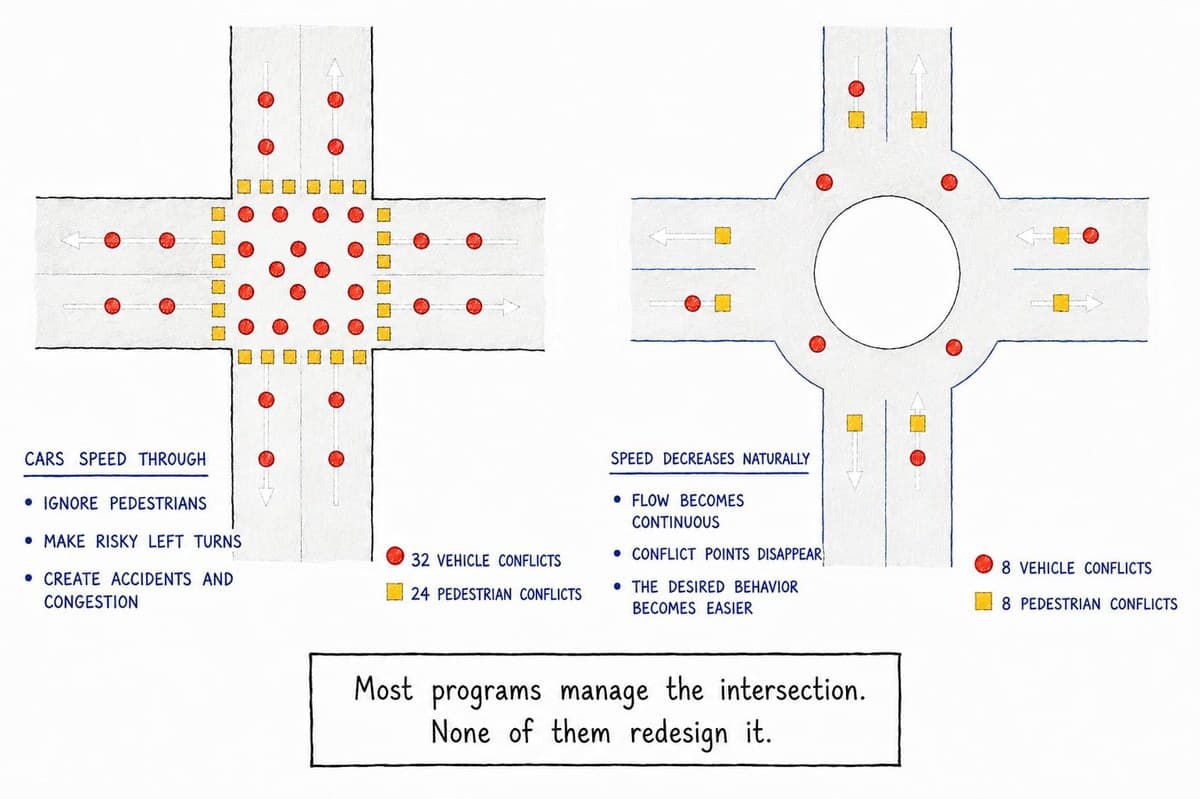
The premise is simple. You don’t enforce permanence. You design it. Make the new behavior easier than the old one. Shut down the alternative. If people reverted, the program didn’t fail at adoption. It failed at design.
Traffic engineers figured this out decades ago, though many of us still struggle.
What the Diagnostic Framework Measures
We identified 83 structural conditions across 13 domains that determine whether new behavior holds after the change program ends. Each one maps to something the organization was built to reward before the change was introduced. Every red or amber result is a predicted workaround.
The domains cover four clusters: program and technology design, operating model and authority structure, people readiness, and sustainment and communications. Here is what a single domain looks like when it’s opened:
| # | Condition | What It Asks | Red Looks Like | Green Looks Like |
|---|---|---|---|---|
| 01 | Performance metric alignment | Do the people-metrics reward the new behavior or the old behavior? | Bonus structure and performance reviews still evaluate people on legacy process metrics | Compensation, bonus, and promotion criteria explicitly reward the new behavior |
| 10 | Consequence for non-adoption | What happens when someone does not adopt the new behavior? | Nothing visible happens when someone continues working the old way | Non-adoption has a consistent, observable consequence that people can see |
| 13 | Risk-reward asymmetry | Is the downside of trying the new behavior greater than the downside of sticking with the old? | Trying the new behavior and failing carries career risk; sticking with the old carries none | The risk of not adopting outweighs the risk of trying; failure during transition is treated as learning |
Domain 1 has 15 conditions. Three are shown above. The full inventory covers 13 domains and produces a readiness profile that tells you, condition by condition, where the environment will resist the new behavior.
For readers familiar with existing change frameworks: ADKAR diagnoses individual readiness. Kotter sequences a change effort. Bridges describes the psychological transition. The 83 conditions diagnose the structural environment around the new behavior, which is the variable those frameworks treat as fixed. A program can run ADKAR cleanly and still drift if the structural conditions are wrong. The conditions are what make the rest of the work hold.
What AI Changed
AI can now generate a change impact assessment, a communications plan, a training outline, and a stakeholder map in minutes. With human review and oversight, this work can be produced faster and to a higher standard than before.
The impact goes past efficiency. AI removed the last excuse for focusing on the wrong work. Any organization can now produce polished change plans at scale, instantly. “We’re too busy building materials to do the harder work” no longer holds.
What most organizations did next was produce more materials, faster.
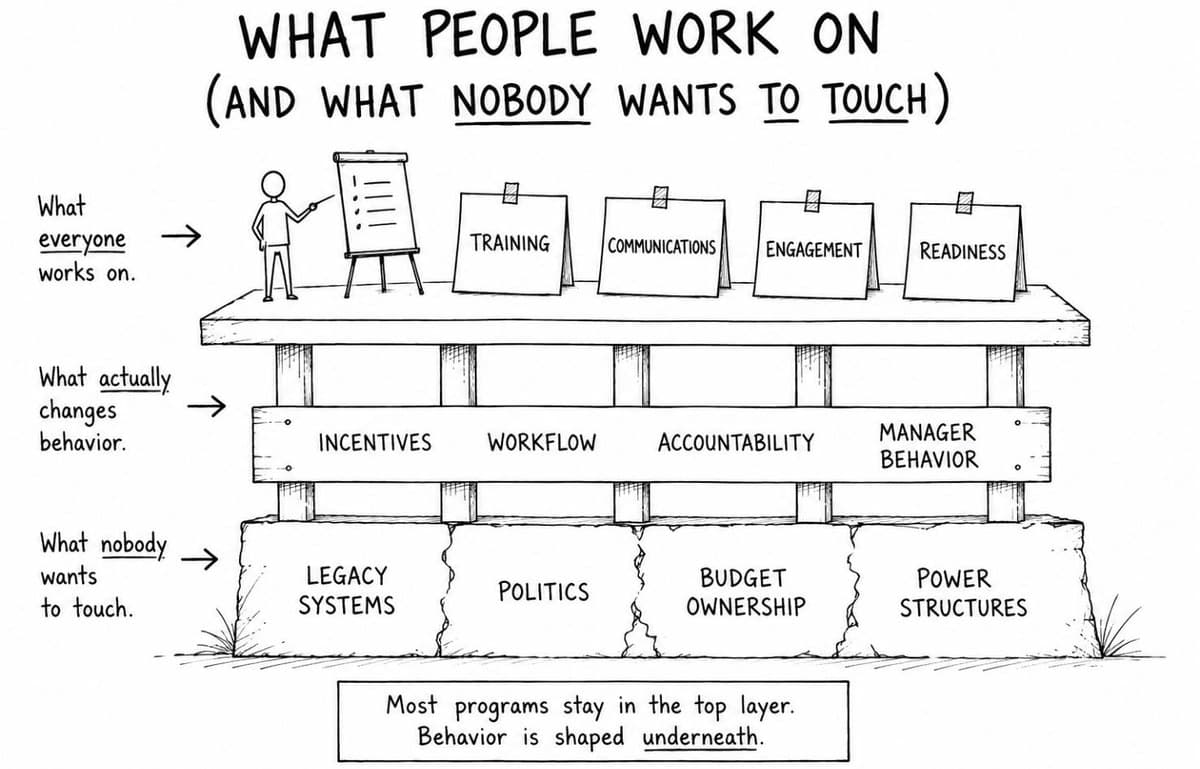
But AI also makes the structural problem worse before it improves it. Previous technologies replaced discrete tasks. AI changes the relationship between a person and their work. It redistributes judgment, collapses decision layers, and moves information access from hierarchical to flat. Those are structural changes to the operating model, not problems that communications and training can solve. Treating them as communications-and-training problems doesn’t just fall short. It guarantees the workaround.
McKinsey surveyed nearly 2,000 organizations. Only 6% of AI deployments are generating real returns. AI high performers are 2.8 times more likely to have redesigned workflows before deployment, rather than adding AI to an architecture that was already failing them.[10] OpCo Intelligence found the same thing. Their 2026 survey of 123 senior operators at companies including Stripe, Anthropic, Databricks, and Microsoft showed nearly 90% adoption of general-purpose chatbots. The tools exist. The binding constraint is organizational, not technical.[11]
The Center for Creative Leadership articulates what this costs at the human level: organizations are asking people to take their biggest professional risks when they feel least safe.[12] No amount of training will close that gap. The gap is structural.
If your team’s capacity was freed tomorrow, where would it go? The structural work that determines whether change holds looks like this: remove the old path so the workaround disappears. Change what managers are measured on. Force irreversible decisions before go-live. Make one team visibly succeed in the new way of working. Audit for workarounds in formation.
If teams are still spending most of their time producing artifacts, that’s no longer a capacity issue. It’s a prioritization decision.
Three Stages, and Where Most Organizations Stall
Every change program eventually hits the same limit: the work it does well (communications, training, stakeholder alignment) changes what people know and what they can do. It does not change what the environment rewards, measures, or makes easy. The question is whether anyone recognizes that as a structural constraint, or asks for more training.
Every metric on the standard change management dashboard measures whether the program executed: training completed, communications sent, system logins recorded, readiness surveys returned. None of them measure whether the organization became something it wasn’t before.
Your program achieved adoption. People can use the new system. Some of them consistently do, which looks like progress on every dashboard you’ll see. But consistent use under favorable conditions is not permanence. Permanence is what happens when the conditions turn against you: month-end close, an audit, a staffing shortage, a key manager leaving. The organizations where the behavior holds through those moments are the ones where the structural conditions were redesigned. The rest revert. Quietly, and then completely.
Most programs measure adoption. Many achieve stabilization. Few achieve permanence. The gap between stabilization and permanence is where most transformation value is lost. It is invisible to every metric on the standard executive dashboard.
Every change program answers the WIIFM. Here’s what the environment answers back: the old way is still easier, the old metrics still apply, and nobody shut down the workaround. The environment’s WIIFM is louder than yours.
Reversion is not random. It follows recognizable patterns.
The organization where the approval chain was never actually redesigned is a different problem than the one where managers stopped enforcing the new standard under pressure. Both are different from the organization where exceptions granted at go-live were never formally closed and became the operating model.
Governance regression requires a different intervention from shadow-system regeneration, in which teams rebuild unofficial tracking tools after legacy systems are shut down. Manager non-enforcement requires a different intervention than exception normalization. The pattern determines what you do about it. Get the pattern wrong, and the intervention addresses the symptom while the structural problem keeps producing the old behavior.
The practitioner who diagnoses governance regression as a training problem will run a leadership workshop. The manager who needed organizational backing to enforce the new standard will attend the workshop and return to the same calculation: enforcement is risky, tolerance is safe. Nothing will change. (The workshop will receive strong evaluations.)
Compliance theater is the invisible failure mode. Projects that don’t collapse often become worse. The dashboard shows 87% adoption. The executive sponsor presents it to the board on a Tuesday. By Thursday, the AP team has rebuilt the reconciliation spreadsheet they used before the system went live. The reports look different. The behavior is identical.
Usage metrics measure login frequency. They don’t measure whether workflows have shifted, whether decision rights have moved, or whether the accountability model reflects the new operating reality. AI accelerates this failure mode. When AI moves decisions out of the hierarchy and into the workflow, the gap between what the dashboard shows and what’s actually happening widens faster than with any previous technology. The sponsor sees 87% adoption and presents it to the board. The frontline sees a system they log into every morning and work around by noon. Both are telling the truth. The metric just isn’t measuring what the sponsor thinks it’s measuring.
Part Two: The Application
Each section below addresses a specific leader. Read the one that fits your role.
For Executive Sponsors
Your system went live. Your people completed the training. Your adoption metrics show one thing. Your operations show another.
You’ve funded the communications and training. It wasn’t enough. The communications and training were funded because they fit the approved budget. The structural work wasn’t funded because no one scoped it, and scoping it would have meant telling the steering committee that the program would cost more and take longer. That’s not a failure of vision. It’s a rational response to the way transformation budgets are approved. You already know this. You approved the budget.
The question you’re facing now isn’t whether to do more of the same. It’s whether anyone is going to name the structural decisions that haven’t been made and go to work on the conditions producing the old behavior.
What the structural diagnosis reveals in your environment:
The decisions that were deferred. Decision rights that were never reassigned. You’ll find metrics that still reward the old behavior, legacy processes running in parallel because nobody had the authority to shut them down, and middle managers carrying four new roles nobody redesigned their job to accommodate.
Or, if you haven’t gone live yet: the conditions that need to be closed before launch, while there’s still time and budget to close them. A structural diagnosis before go-live prevents stranded investment. After go-live, you’re diagnosing damage that already happened.
What the engagement looks like:
An Adoption engagement addresses the full change program with structural intent: environment design alongside the communications and training, so the conditions that produce old behavior are closed before they produce workarounds.
A Permanence engagement’s principal works with you on the systemic decisions that make the change irreversible: removing the option to revert, tying accountability to sustained behavior change, eliminating the workaround before it becomes the default.
The qualifying question we’ll ask you:
“How much of this do you want to stick, and what are you willing to do structurally to make sure it does?”
Your answer tells us whether you have the authority and the will to make the structural decisions the engagement requires. It also tells us which engagement the conversation is heading toward.
Start here: The Sponsor Assessment covers 13 structural condition domains and produces a red/amber/green readiness profile for your transformation. 14 questions. Most executives finish in under 5 minutes. It’s free.
For Frontier-Tech Operators
Your organization moves too fast for formal change programs. Communications go stale in days. Training feels like overhead. Your engineers resist anything not tied to mission outcomes. You know the standard change management playbook won’t survive contact with your culture.
You’re right. That playbook was designed for organizations that tolerate process theater. Yours doesn’t.
The problem you’re facing has a different name than the one you were told. It’s environment design. You’re scaling faster than your operational systems and leadership infrastructure can support. Your next ERP rollout or platform implementation has to work the first time, with mission-critical stakes and no margin for error. Your leaders were promoted for technical brilliance and are under-equipped to coach, communicate, and reinforce change. Your tribal knowledge lives in Slack threads. Your new hires are smart and undertrained.
The question that fits your culture is not “how do we get people on board.” That’s a communications question, and your teams will tune it out. The question is: how do we design an environment where the new behavior is the only available behavior?
That’s the same logic your engineering leaders already use for technical architecture, applied to the operating model instead of the codebase.
IGNITE brings environment design, not a communications-heavy change program. The work is sprint-aligned and structural, focused on operating conditions rather than artifacts. It produces decisions, not decks: shut down the old system, change the scorecard, redesign the approval chain, make the new process the only process.
We built this thesis inside Fortune 500 programs over three decades. Our work with a defense-tech firm convinced us it applies to organizations scaling at your speed. The structural patterns are the same. The operating tempo is different, and we’re still learning what that changes.
Start here: The Operator Stress Test covers the same 13 structural domains in operator language. Built for leaders who would never take a “change management survey.” Same diagnosis, different entry point. It’s free.
For PE Operating Partners
Your value-creation thesis assumed behavior change that the operating environment isn’t structured to produce.
The integration is behind. The management team says they need more time, but the thesis has a clock. The operating improvements you modeled aren’t showing up in EBITDA. Your operating playbook produces results at some portfolio companies and stalls at others. The variable isn’t the playbook quality. It’s the operating environment around the playbook.
We’ve seen this from the inside. We led organizational change management for an ERP implementation within a PE-backed spinout: new ownership, a new leadership team, a new ERP, and a pending acquisition, all in flight simultaneously. The communications went out. The training ran. The system went live. But the underlying architecture hadn’t moved. The workarounds were forming before launch. The technology decision had been made at the deal thesis level. The operating conditions that determined whether it held were never addressed at any level. That’s the pattern. The operating partner models the returns. The implementation team builds the system. Nobody redesigns the environment that will decide whether the workforce uses it or works around it.
Bain’s 2025 Global Private Equity Report quantifies the cost. Carve-out revenue and margin improvements, which once reached 31% and 29% before 2012, have fallen to 17% and 2%, respectively. The common denominator among top-quartile carve-outs is what Bain calls an unbreakable link between the value-creation thesis and the new company’s operating setup.[13] When that link is missing, the thesis stays on the page, and the value leaks through the floor.
The PE-backed spinout is where we first saw the full pattern compressed into a single environment. That engagement convinced us this market needs its own diagnostic, not an enterprise assessment repackaged in portfolio language. The Portfolio Conditions Scan is built for that. It’s newer than the Sponsor Assessment. The structural logic underneath it is not.
Here’s what that looks like in practice. A Portfolio Conditions Scan maps the 13 structural condition domains against the portfolio company’s operating environment during a 20-minute facilitated session. Inputs: your investment thesis, integration goals, operating improvement targets, and transformation milestones. Outputs: red/amber/green by domain, conditions threatening EBITDA realization, conditions threatening adoption, and the specific structural decisions required.
A Permanence engagement puts IGNITE’s principal in the room with the portfolio company CEO to make the thesis hold: eliminating the workaround before it becomes the operating model, tying leader accountability to sustained behavior change, and removing the conditions that produce the gap between the model and the results.
The question that frames the conversation:
“Is the operating environment capable of producing the value-creation thesis?”
If the answer is yes, you don’t need IGNITE. If the answer is “we’re not sure,” the Portfolio Conditions Scan tells you in fifteen minutes.
Contact: miguel.guevara@ignitena.com
The Test
Return ninety days after launch.
Not to check on progress. Not to write the close-out report. To answer one question: is the behavior holding because the structure supports it, or did the conditions pull it back?
That question makes people uncomfortable. It should. Most close-out reports are written to confirm the program succeeded. This one is written to find out whether it actually did.
Most change programs measure go-live completion. The dashboard turns green, the consulting firm writes the close-out report, and six months later, the CFO asks why the technology isn’t delivering the returns the business case promised. The answer is almost always the same: the behavior changed during the program, then the conditions pulled it back.
Permanence requires more than time. A transformation that holds for 90 days under ideal conditions is not the same as one that holds at month-end close, during an audit, amid a staffing shortage, or when a key manager leaves. The organizations that sustain transformation are those in which the structural conditions are redesigned: not just the system or the process map, but also the incentives, the decision rights, the accountability structure, and the fallback paths. When those conditions are right, the behavior holds because it has nowhere else to go.
Permanence isn’t enforced. It’s designed. The environment makes the new behavior easier than the old one. The workaround path is closed. The scorecard measures the right thing. The approval chain reflects the new process. Nobody has to remind anyone.
If the behavior didn’t hold, the program didn’t fail at adoption. It failed at design.
That’s the only metric that matters. What would yours show?
Find Your Entry Point
| # | You Are... | Start Here | What You’ll Get |
|---|---|---|---|
| 01 | An executive sponsor or transformation leader | Sponsor Assessment → | Red/amber/green readiness profile across 13 structural domains. 14 questions, under 5 minutes. |
| 02 | A frontier-tech operator or engineering leader | Operator Stress Test → | Same 13 domains, operator language, sprint-aligned. Built for leaders who reject process theater. |
| 03 | A PE operating partner or portfolio manager | Portfolio Conditions Scan → | Facilitated 20-minute session mapping structural conditions against your value-creation thesis. |
| 04 | A change practitioner or PMO lead | Free OCM Plugin → | Handles impact assessments, comms plans, training outlines, stakeholder maps. Free your team to do the structural work. |
All three diagnostics are free. The plugin is free.
Ready to diagnose your transformation now? Schedule a Structural Conditions Review: miguel.guevara@ignitena.com
IGNITE Consulting’s change-management plugin handles the work that eats a change team’s time: impact assessments, comms plans, training outlines, stakeholder maps. What used to take weeks takes minutes. Human review makes it better. That frees the team to do the work that determines whether adoption holds. Remove the old path so workarounds disappear. Change what managers get measured on and force the decisions that can’t be reversed before go-live. Let one team succeed visibly in the new way so others follow. Then watch for workarounds forming early, because they will. All three diagnostics are free at ignitena.com/diagnostics.
Part Three: For Practitioners
The evidence base behind the structural conditions thesis. If you work in change management, program management, or organizational design, this section provides you with the data, market analysis, and engagement model in full.
The Traditional Model and Its Structural Flaw
The conventional change management approach was built around a logical but flawed premise: build the right artifacts, deliver them well, and behavior change will follow.
Success gets measured by what gets produced. Plans created, emails sent, trainings completed, dashboards showing green. None of them measure whether teams are actually ready to work differently on Day One, or whether behavior change is holding ninety days after go-live.
The structural flaw is in who owns what. Change teams build the plans. Leaders own the outcomes. But leaders are kept informed rather than accountable. The change function operates as a support function, working alongside the business rather than inside the accountability structure that actually drives behavior.
BCG studied 225 transformation programs and found the primary drivers of failure were four hard-side factors: project duration, team capability, management commitment, and the additional effort required of employees beyond their day jobs. Twenty years ago, the data already pointed to operating conditions rather than people.[1]
Matt MacInnis, COO of Rippling, arrived at the same conclusion from an operator’s seat: leaders make a fundamental error by over-rotating on outputs rather than engineering the inputs that produce them.[2] Screaming about the score doesn’t change the plays. Change the plays, and the score follows.
The organizational design literature explains why. Ben Horowitz frames organizational design as a communications architecture: every structure optimizes some paths at the expense of others.[3] When new technology changes who has information and who has decision rights, the old paths become liabilities. The structural move is to redesign them deliberately, before they reassert themselves as informal workarounds.
Academic research. Operator experience. Organizational design theory. All three converge on the same point. The data has been pointing at operating conditions for two decades. The market hasn’t built around it.
The budget tells the same story. Deloitte found that 93% of AI budgets are spent on technology. Seven percent goes to the people expected to use it. Companies that focus solely on technology are 1.6 times more likely to report that their AI investments fall short.[4]
The misalignment isn’t philosophical. It’s structural, down to the budget line.
Why the Market Never Built Around It
If the data has been pointing at operating conditions for twenty years, why is the market still organized around communications and training?
Not because practitioners missed the problem. Most experienced change managers can describe exactly where the environment works against them. They see the metrics rewarding old behavior. They see the legacy system running in parallel. They see the middle manager taking on four new roles that nobody scoped. Prosci’s own research identified mid-level managers as the group most resistant to change, with 43% of practitioners naming them as such.[5] The discipline understood the problem. It couldn’t sell the solution.
Change management is introduced into most organizations as a percentage of a larger program budget. Five percent. Maybe ten. Gartner recommends allocating at least 15% of the overall system implementation budget to change management. Yet among companies managing large projects over $1.5 million, 77% reported spending less than 10%.[6] The scope is set before the change lead is hired.
The math gets worse at the program level. Consulting labor routinely constitutes 40 to 60 percent of total ERP program cost.[7] If change management is getting less than 10% of that same budget, the structural subordination is built into the deal before anyone writes a scope document. No firm is going to put a $50 million technology program at risk to argue for a bigger change management scope.
That shapes who survives. The practitioners who make it in that model stop fighting for environment-level work and start optimizing the volume of deliverables. The firms that staff it optimize accordingly: solution centers, junior practitioners, offshore resources. When you move change management into a shared services model staffed at that level, you’ve made an architectural decision about what kind of work it can do. Nobody in a solution center is walking into a sponsor’s office to say the operating model needs to change.
And the sponsor relationship matters more than anything else. Prosci’s research shows that projects with extremely effective sponsors are 79% likely to meet their objectives, compared to just 27% with extremely ineffective sponsors.[5] But the person closest to the problem was never positioned to have the harder conversation. The staffing model prevents it.
McKinsey documented what happens next. Organizations fail to sustain impact because performance disciplines end with the transformation effort, incentives and budgets are not aligned with new objectives, and management teams stop investing in the future.[8] BCG found the same pattern: most transformations fall short, and what often distinguishes success from stagnation is whether incentives are directly linked to transformation goals.[9]
Prosci’s reinforcement data closes the loop. Among organizations that allocated resources to reinforcement and sustainment, 67% met or exceeded their objectives. But while 81% of organizations plan for reinforcement, only 55% actually resource it.[5] The budget was spent. The project closed. The reinforcement activities that would have addressed the operating environment were the first to be cut when the timeline was compressed. They are always the first thing cut.
The market didn’t accidentally solve the wrong problem. The way change management gets bought and sold made the wrong problem the only one that fit the budget.
Why Conditions Determine Outcomes: The Extended Evidence
Demonstrated value moves organizations. Mandates don’t.
OpCo’s 2026 operator survey directly addresses this.[11] One practitioner describes building a performance management tool over a weekend, showing it to skeptical colleagues, and using the tangible result to shift their perception. Not a town hall. Not a communications cascade. A specific person showing a specific team what good looks like, and the environment shifts around that demonstration.
The implication is precise: you cannot communicate your way to sustained behavior change. Someone has to show what the new way of working produces before the organization will reward it. That’s a leader conversation, not an artifact.
PE-backed environments concentrate every risk factor at once, and the gap between investment thesis and operating reality has a clock on it.
We led organizational change management for an ERP implementation within a PE-backed spinout: new ownership, a new leadership team, a new ERP, and a pending acquisition, all in flight simultaneously. The communications went out. The training ran. The system went live. But the underlying architecture hadn’t moved. The workarounds were forming before launch. The technology decision had been made at the deal thesis level. The operating conditions that determined whether it held were never addressed at any level. That’s the pattern. The operating partner models the returns. The implementation team builds the system. Nobody redesigns the environment that will decide whether the workforce uses it or works around it.
From Diagnosis to Permanence: How the Engagement Runs
The 83 conditions are the operational entry points into the environment argument.
An engagement moves through a clear sequence. Orient to the organization’s specific context. Map where the change touches the operating model and who holds the decision rights it requires. Diagnose resistance by type (environmental, capability-based, or political) so the intervention targets the root cause. Surface the dependency chain from open decisions to go-live readiness. Every unresolved decision is a potential workaround in formation.
The work then shifts to sponsor activation and readiness measurement. The practitioner provides a specific list of irreversible commitments the sponsor must make before go-live. Not budget approvals or town hall appearances, but the decisions that close optionality. Closing the legacy system instead of running both in parallel. Tying leader accountability to sustained behavior change, not go-live completion. Removing the workaround before it becomes the default.
Readiness gets measured against structural conditions, not activity. “Manager scorecards updated” instead of “training complete.” “Legacy system access removed” instead of “communications sent.”
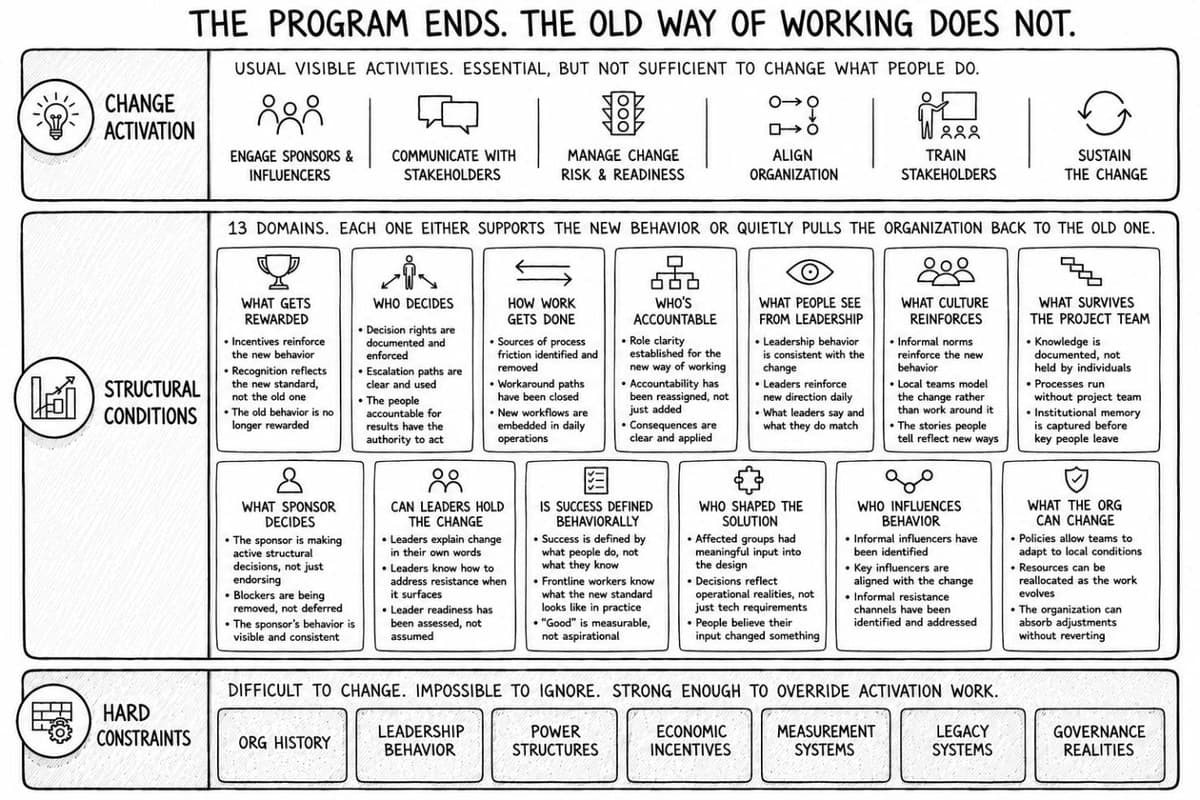
Before go-live, the full 83-condition inventory produces a readiness profile showing, domain by domain, where the environment will resist the new behavior. Every red or amber condition is a predicted workaround.
At engagement close, the only question that matters is whether the conditions are holding. Not whether artifacts were produced.
Sources
- [1]
Perry Keenan, Alan Jackson, and Hal Sirkin, “The Hard Side of Change Management,” Harvard Business Review. October 2005; republished by Boston Consulting Group. Study of 225 large-scale transformation programs. bcg.com
- [2]
First Round Review, “Everything in Business is About Fighting Entropy: Here’s How Rippling Does It,” First Round Review. December 15, 2024. Quoting Matt MacInnis, COO of Rippling. review.firstround.com
- [3]
Ben Horowitz, “Taking the Mystery Out of Scaling a Company,” Andreessen Horowitz. August 1, 2010. a16z.com
- [4]
Deloitte, “Organizations Stand at the Untapped Edge of AI’s Potential,” Deloitte. January 20, 2026. Drawing on the 2025 Deloitte CXO Survey. deloitte.com
- [5]
Prosci, Best Practices in Change Management, 12th Edition. 25 years of research from 10,800+ professionals globally. Findings on sponsor impact (79% vs. 27%), mid-level manager resistance (43%), and reinforcement resourcing (81% plan, 55% resource). empower.prosci.com
- [6]
Judge Group / Gartner, “The Keys to Successful Organizational Change: Understanding the Cost of OCM.” Gartner’s 15% minimum recommendation; 77% of companies managing projects over $1.5M spend less than 10%. judge.com
- [7]
Panorama Consulting Group, cited in IT Consulting Authority, “ERP Consulting Services.” Consulting labor as 40–60% of total ERP program cost. itconsultingauthority.com
- [8]
McKinsey, “Common Pitfalls in Transformations: A Conversation with Jon Garcia,” McKinsey & Company. 2022. Analysis of transformation failure patterns, including misaligned incentives and budgets post-transformation. mckinsey.com
- [9]
BCG, “To Keep Transformations on Track, Incentives Are Crucial,” Boston Consulting Group. 2025. Three out of four transformations fall short; incentive alignment distinguishes success from stagnation. bcg.com
- [10]
McKinsey & Company, “The State of AI: Global Survey 2025.” Survey of nearly 2,000 organizations. mckinsey.com
- [11]
Operator Collective / OpCo Intelligence, “State of AI Transformation 2026,” LinkedIn. March 3, 2026. Survey of 123 senior operators. linkedin.com
- [12]
Center for Creative Leadership, March 2026.
- [13]
Bain & Company, “Global Private Equity Report 2025,” Bain & Company. March 2025. Carve-out revenue/margin improvements fell from 31%/29% (pre-2012) to 17%/2%. Top-quartile performance linked to alignment between value-creation thesis and operating setup. bain.com